Pressure Cooker

I inherited a pressure cooker (among other things) from my Grandmother. I have been wanting a pressure cooker, but have always been a little scared of them. When I was considering buying one, there were a couple features that really appealed to me. The first was the cooking speed and the second was the higher pressure cooking things more completely. Living in Denver, I have had a lot of trouble cooking beans till they are soft like a canned bean.

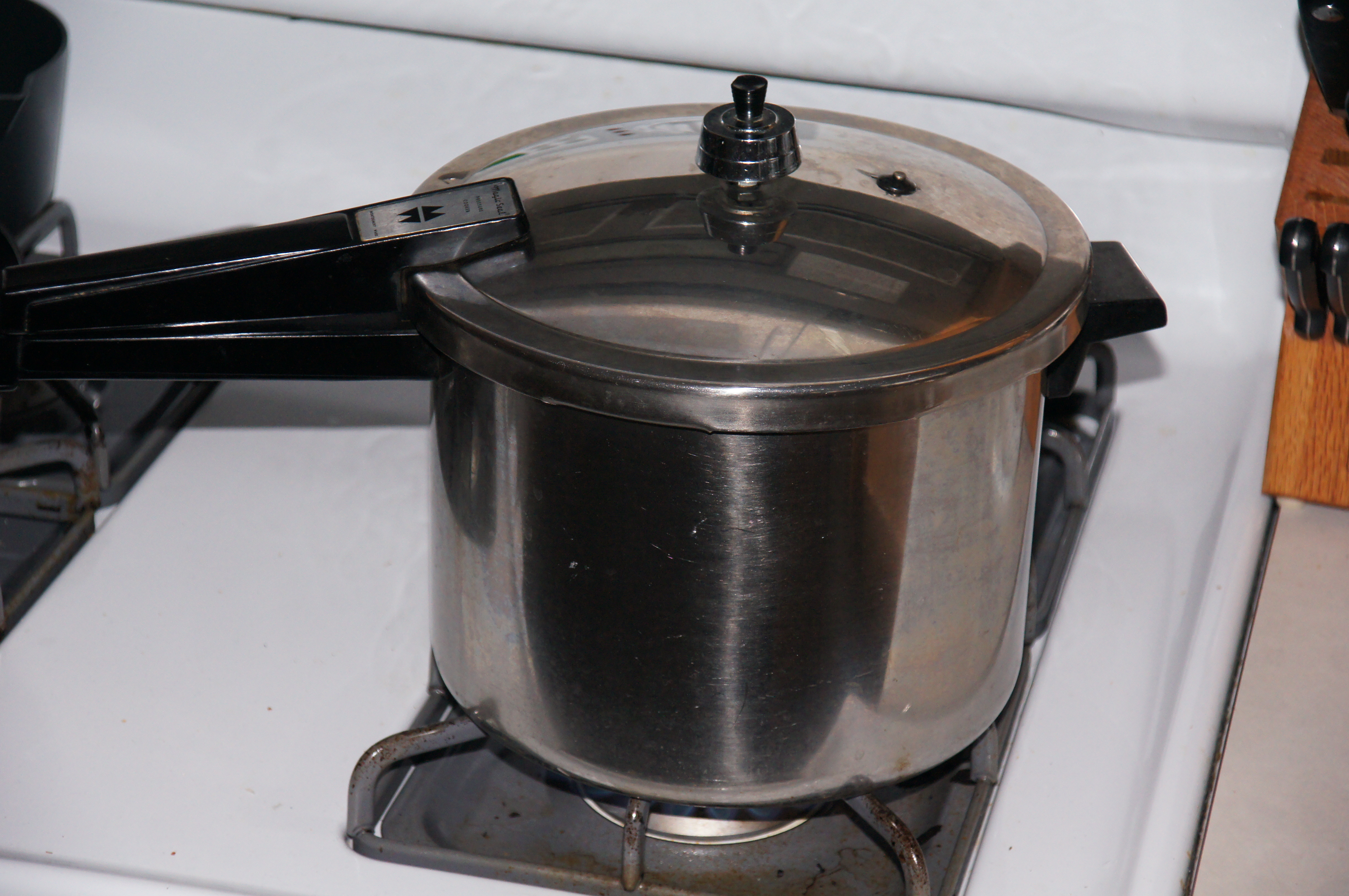
The pressure cooker that I inherited is an older model “Magic Seal” that has a rocking 15 PSI weight and a safety gasket. I was pleasantly surprised to find that the rubber seal (not pictured) was still in good shape and that you can still get parts for this model online.
I have tried a lot of different foods and have had mostly good results. Beans come out soft and creamy. Tough cuts of meat can be cooked quickly. Chicken becomes shreadable in 20 minutes. If you haven’t used a pressure cooker before, it is similar to making something in a crockpot except that hours worth of slow cooking are replaced with 30 minutes of pressure cooking.

My favorite foods to pressure cook are pinto beans, steel cut oats and Dutch vegetable whip. The last is a recipe that was included in the instruction manual:

3 c. diced potatoes
1 c. diced carrots
1 tart apple, peeled and sliced
1/2 onion, sliced
1 c. water
1 tsp. salt
1/8 tsp. pepper
2 tbsp. butter
1 tsp. chopped parsley

Place all vegetables in a pan (except parsley) with water and cook until vegetables are done. Mash, add butter and whip until fluffy. Garnish with parsley. If you have a pressure cooker, cook 3 minutes at 15 pounds of pressure. Cool cooker at once.


I was a little disappointed with cooking brown rice. I had hoped to save time, but by the time the cooker comes up to pressure and then slowly comes back down to normal pressure, the time savings isn’t much at all. Same with steel-cut oats. It takes longer (about 45 minutes total) in the pressure cooker instead of ~15 minutes on the stove top. Of course the oats are so much softer and creamier after pressure cooking, so it is worth the extra time. Anything that can be cooked with the “fast release” method (running the cooker under cold water to quickly drop the pressure) is significantly faster. But all the grains and beans are “slow release” (meaning you just wait for the pressure to drop on its own).

Something that I hadn’t really considered is how much less energy it takes to cook some foods. Once the pressure cooker comes up to pressure it takes a very low setting to keep it going. And since the cooking time is already much shorter you use quite a bit less power. I don’t really have a good feel for how much gas it takes to cook compared to a water heater or furnace, so I don’t know how much this really matters.

Price Tracker

I am starting development of a tool that will track the price of items at Amazon.com. I will build a wishlist of items and the program will check the price of each item daily. It will let me know if the item is on sale and what the current discount is.

There are tools online for doing the same thing, but I’d rather not enter my wishlist into a website and I’d rather not get more email.

Since the program is for my own use, I’ll add items to the tracker by going to Amazon.com, finding the item, and then entering the ASIN into the program.

The program will use Amazon’s Product API to get a bit of product information and the current price.

I am going to write this program in C#. I will be able to re-use quite a bit of code from my MediaDB application which also uses the Amazon Product API.

Tomato Conserva

I made some “tomato conserva” today. I started with 3 lb of tomatoes and ended up with 6 oz of a thick tomato paste. The flavor is incredible though. It is like tomato essence. I got the idea from here:


I’ve also been processing the basil harvest. So far I have spent two hours picking basil leaves off the plants and I probably have another hour to go. I am drying most of it, but I have frozen one batch.

Goodbye paycheck

Today was our last day at Raytheon/Solidyn. After about 15 years as a software developer in the aerospace industry, I am retiring to pursue my own interests. I plan to do more reading, play the violin, and write the software that I want to write.


I’ve had some good experiences, made some friends, and learned some skills at work. But it has been a long time since I have enjoyed the job or found it fulfilling.


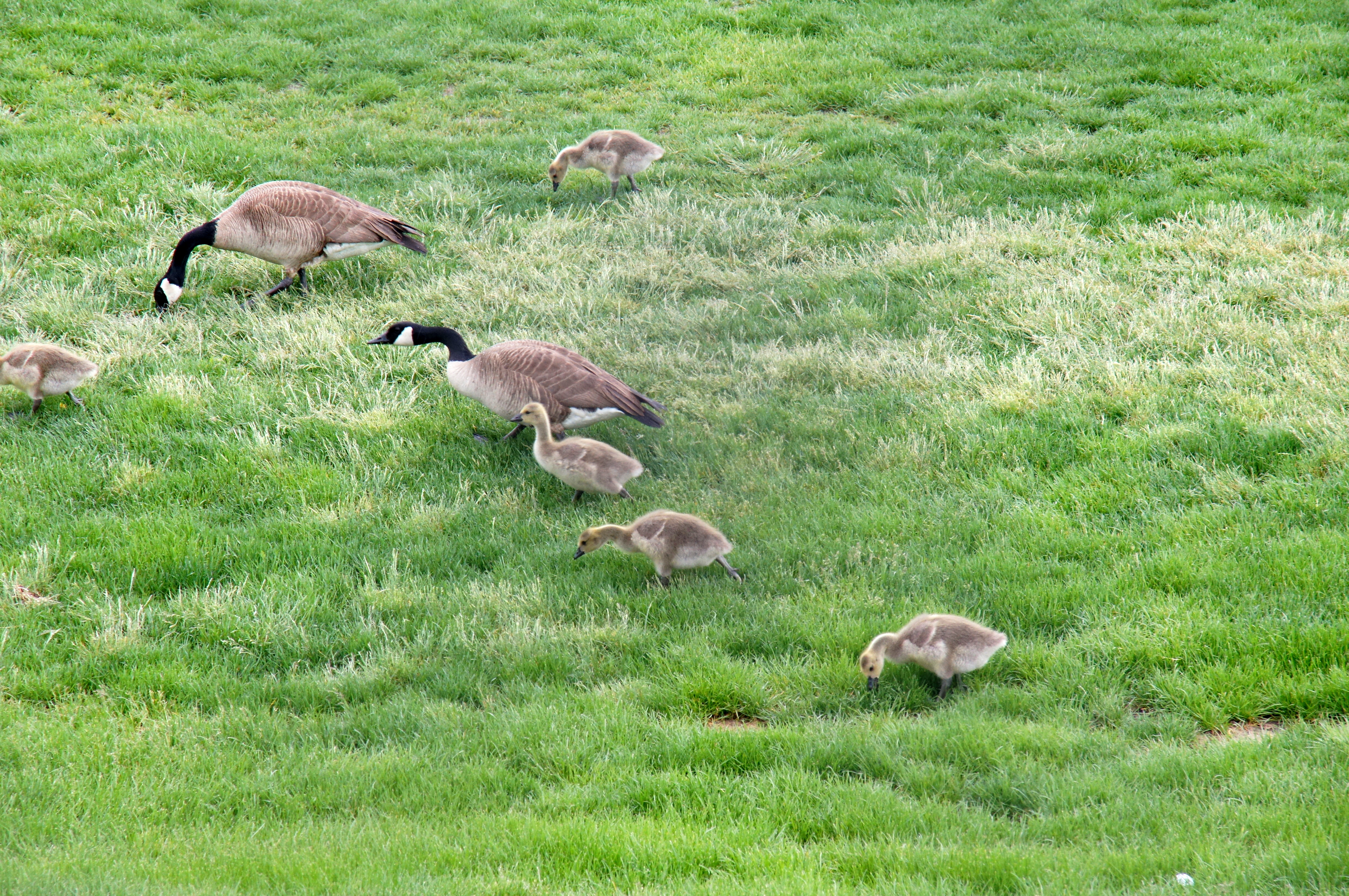
I will mostly miss the non-work parts of work. The opportunity to meet interesting people, the daily walks by the golf course, and the geese.

Trip to Las Vegas

We took a trip to Las Vegas with a friend to see the Star Trek convention. It was the 45th Anniversary and Leonard Nimoy’s last appearance. We also rented a car and went to the Hoover Dam and took the tour. We also went to an “Ice Bar” called Minus 5. The room was mostly made of ice and kept at -5 degrees C. They gave us coats and gloves when we went in. And the drink glasses were made of ice. The full set of pictures is here.

SimFinance Progress Update

The SimFinance application is mostly done.

As is always the case, the software was more complex than I thought it would be. The main complications were due to the fact that my partner and I aren’t married. So the application had to try to optimize who paid the bills to manage the size of each of our accounts and how much taxes we each had to pay. The other big complication was trying to manage our traditional and Roth IRAs to minimize taxes each year.

There are some big things yet to do:

  1. Come up with a model for stock dividends. Right now, dividends are simply included in the return of the S&P. However, that is not really accurate, as the yield of dividends lags behind changes in stock prices. Also, taxes are due on dividends the year they are paid instead of the year the stock is sold. Those two differences may end up balancing each other out in the overall results.
  2. Investment strategy comparison. Would dividing our money between bonds, i-bonds, and stocks be better overall than having everything in stocks? Does the reduction in volatility pay off? Or is it better to just accept the volatility and maximize returns?
  3. More optimization post 60. The order of IRA withdraws should change after 60. Need to model medicare.

The model is giving us an 85% chance of success right now. I don’t really think that the things that are left to do will change this number significantly. It is surprising how much money we have to have to get a 95% chance of success and how much variation there is in the possible outcomes.

It is possible that treating the S&P 500 as a random distribution is wrong. While the historic data looks random, there probably are some underlying “fundamentals” that keep the stock prices within a range. I am not sure how to add that to the model besides trying to put an overall cap on the market returns.

Student-t distribution for stock returns

I have been working on the SimFinance 2.0 application and have been struggling to find a way to simulate the stock market. (Note: I am not trying to predict the stock market, I just need a way to generate a random stock market return that is similar to historic returns)

My first idea was to use a normal distribution centered around the average return with the same standard deviation that the real data has. This was close to correct, but if I plotted sample returns from history against the normal distribution, the historical returns had much longer tails. Meaning that, in reality, there are more really bad and really good years than there would be in a normal distribution.

After doing some research (I am not the only one interested in simulating the stock market), I found that some people are using a Student-t distribution. After playing with the parameters of that distribution I was able to get a much more realistic curve. Based on the historical data for the S&P 500, I am using the following parameters for the distribution: DOF = 3.40234, SCALE = 35, OFFSET = 0.00725

In software, I am using the boost library to generate random numbers according to the student-t distribution.

SimFinance 2.0

I am starting work on SimFinance 2.0.

A long time ago, I tried to create a retirement analyzer/simulator. It would allow a user to enter everything about their finances, including their plans for the future. It then simulated the future by generating thousands of possible scenarios and displaying your odds of still having money when you die. It built these futures probabalistically based on historic performance of different investment types, the user’s life expectancy, etc. The project was too ambitious and I never completed it.

Now, as I consider retirement, I’d like to have this tool. And I realized that I could complete the project if I would limit the scope to just my own situation. It wouldn’t be useful for other people, but it would give me a better idea if I can really retire.

The old project was created with C++ and wxWidgets. I would like to build the new version in C# because it would be easier to create the user interfaces. But C++ would be faster for simulating thousands of futures month by month. It would also let me re-use some of the code from the original project. So I am going to compromise and build it with C++/CLI. I can use the GUI builder and the .NET libraries and also have the speed of native C++ for the time critical parts of the code.

Practice Log – completed

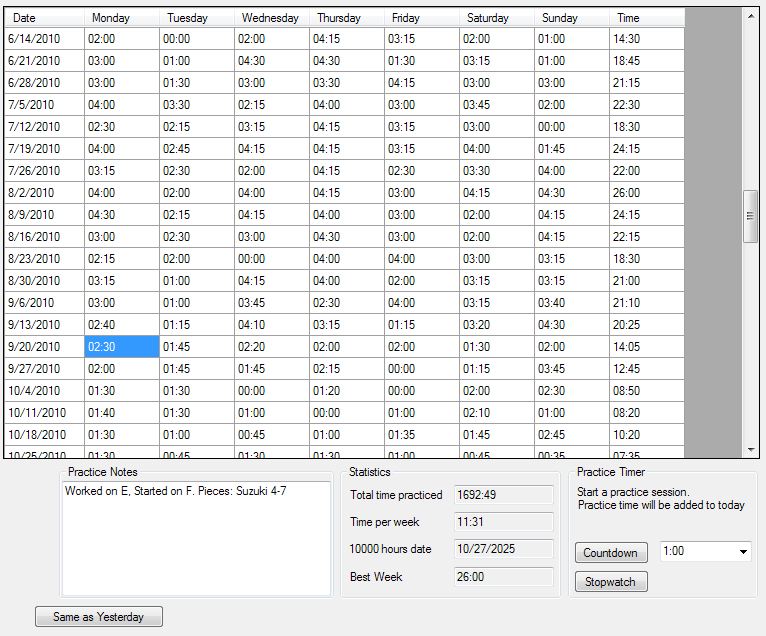
I have finished the PracticeLog software. Here is what it looks like:


I am happy with the software. I created countdown and stopwatch timer modes so that the program will time my practice and automatically update the log for today. I added the “Same as Yesterday” button since I practice a particular set of pieces for at least a week at a time.

I also put in a “10000 hours date” field. This is the date when I will have practiced 10000 hours. I have recently read Outliers by Malcolm Gladwell and am intrigued by the notion that, while talent matters, becoming an expert is mostly a matter of putting in the time practicing.